


If you’ve landed here after Googling “Should I hide vegetables in my child’s meals?”, “My child won’t eat vegetables” or “How do I get my picky eater to eat vegetables?”, you’re certainly not alone.
Whether you have a toddler refusing their carrots, a 7 year old who pushes every vegetable aside or preschooler who seems to survive on yoghurt and toast, you’ve probably sneaked in those veggies on more than one occasion (veggie bolognese to the rescue!). But then you’ve seen that it is apparently not good to hide vegetables but you wonder how on earth can you get this sweet little child of yours to JUST. EAT. THEIR.FREAKING.VEGETABLES???
And guess what, most of us think the same.
According to the Australian Bureau of Statistics, around 95% of Australian children aged 2–17 years don’t eat the recommended amount of vegetables each day. Faced with that reality, it’s no surprise that many parents start blending spinach into smoothies, stirring carrot into pasta sauce or hiding zucchini in muffins.
Those strategies can absolutely help increase vegetable intake, particularly during busy weeks or if you have a particularly selective eater.
But they also made me stop and think.
If my children never see vegetables, how can they ever learn to like them?
That simple question completely changed the way I thought about fussy eating.
The more I read about children’s eating behaviour, the more I realised we might be asking the wrong question. Rather than focusing only on how to get vegetables into our children, perhaps we should also be asking how children actually learn to like vegetables in the first place.

Why won’t my child eat vegetables?
If you’ve ever wondered whether your child is simply a picky eater, you’re not alone.
One of the most reassuring things I learnt is that refusing vegetables is incredibly common and, in many cases, a normal part of childhood development.
Many vegetables naturally contain bitter compounds, and young children are more sensitive to bitter tastes than adults. Unlike foods such as bread, cheese or rice, vegetables can also vary in texture, colour and flavour depending on how they’re prepared, making them feel less predictable and, for some children, less appealing.
Research from CSIRO VegKIT explains that children’s food preferences are learned rather than fixed. They aren’t born loving broccoli. Instead, they gradually become more accepting of vegetables through repeated, positive experiences over time.
The Raising Children Network shares a similar message, encouraging parents to continue offering vegetables regularly, involve children in shopping and cooking where possible, and avoid turning mealtimes into a battle.
Reading that was a huge relief.
Like many parents, I’d been measuring success by what happened at dinner. If the vegetables were eaten, I felt like I’d done a good job. If they weren’t, I questioned whether I should be doing something differently.
The research helped me realise I was looking at the wrong measure of success.
Maybe success wasn’t getting my children to eat their carrots tonight. Maybe success was helping vegetables become a normal, familiar part of their world.
How do children learn to like vegetables?
One of the biggest shifts in my thinking came when I stopped asking, “How do I get my child to eat vegetables?” and started asking, “How do children actually learn to like vegetables?”
They’re not the same question.
It’s easy to think success is getting a mouthful of veggies into your child tonight. But the research suggests that building a lifelong acceptance of vegetables is a much longer process.
Children develop food preferences gradually. They learn by experiencing foods over and over again in different situations and without pressure. Sometimes that involves tasting them. Other times it simply involves seeing them, talking about them or becoming curious about them.
That’s why many feeding experts encourage parents to think beyond what happens at the dinner table.
A trip to the supermarket becomes an opportunity to talk about different vegetables. Cooking dinner together becomes a chance to wash mushrooms, peel that potato or stir the pumpkin soup. Growing herbs in the garden, reading books about vegetables or noticing the different colours of veggies on a plate all help children become more comfortable with foods that might once have felt unfamiliar.
None of those moments guarantee your child will suddenly start eating broccoli, but together, they help create something that’s incredibly important: familiarity. And familiarity makes trying something new feel a little less daunting.
Progress doesn’t always look like a clean plate
I used to think I could judge whether dinner had been successful by what was left on the plate. The truth is, what was left on their plates often determined the mood I carried into the rest of the evening .If they didn’t eat what I hoped they would, I’d often feel frustrated, or worse, like I was somehow failing. Looking back, I realise I was measuring the wrong thing.
Progress isn’t always obvious, especially if you have a child who won’t eat vegetables or a particularly fussy eater. Sometimes progress looks like asking why beetroot leaves purple stains on hands, or pointing out the pumpkin in the supermarket, and even not protesting if the green bean is sitting on the plate.
Those moments are easy to dismiss because they don’t look like the outcome we’re hoping for. But they’re all part of the process of learning about food. Once I understood that, dinner became a lot less stressful for me (and probably for my kids) Instead of trying to win every meal, I started focusing on creating lots of small opportunities for vegetables to become a normal part of family life.
That felt like a much more achievable goal.
A different way to think about vegetables
Alright mum, here is what you can do!
After reading what felt like half the internet and googling every variation of “my child won’t eat vegetables”, I eventually came to a slightly disappointing conclusion: there probably wasn’t going to be one magic strategy that would suddenly make my boys love vegetables. Instead, I started thinking about all the different opportunities I had each day to help vegetables become a normal part of our family life.
That didn’t mean changing everything overnight (which I didn’t have time to anyway, the laundry basket was too full!)
It meant continuing to serve vegetables with meals, even if they weren’t always eaten. It meant involving my children when I was cooking, talking about the different vegetables we were buying and trying to make food something we explored together rather than something we argued about. Some nights that was easy but let’s be honest here other nights it felt like a shitshow.
Like every family, we still had dinners where the vegetables came back untouched. There were evenings when someone announced they didn’t like something before they’d even tasted it or proudly announced “that’s disgusting”. None of that disappeared.
What changed was the pressure I put on myself.
Instead of asking, “How do I get my child to eat vegetables tonight?”, I started asking, “How can I help vegetables become a normal part of my child’s world?”
For me, that was a much more helpful question.
It shifted my focus from trying to win one meal to thinking about what I was trying to achieve over the long term.
Where pasta fits into the picture
That shift in thinking eventually became the foundation of Little Eaters.
Pasta was already one of the few foods I knew my children would happily eat, so instead of fighting that, I started wondering whether it could become another opportunity to build familiarity with vegetables.
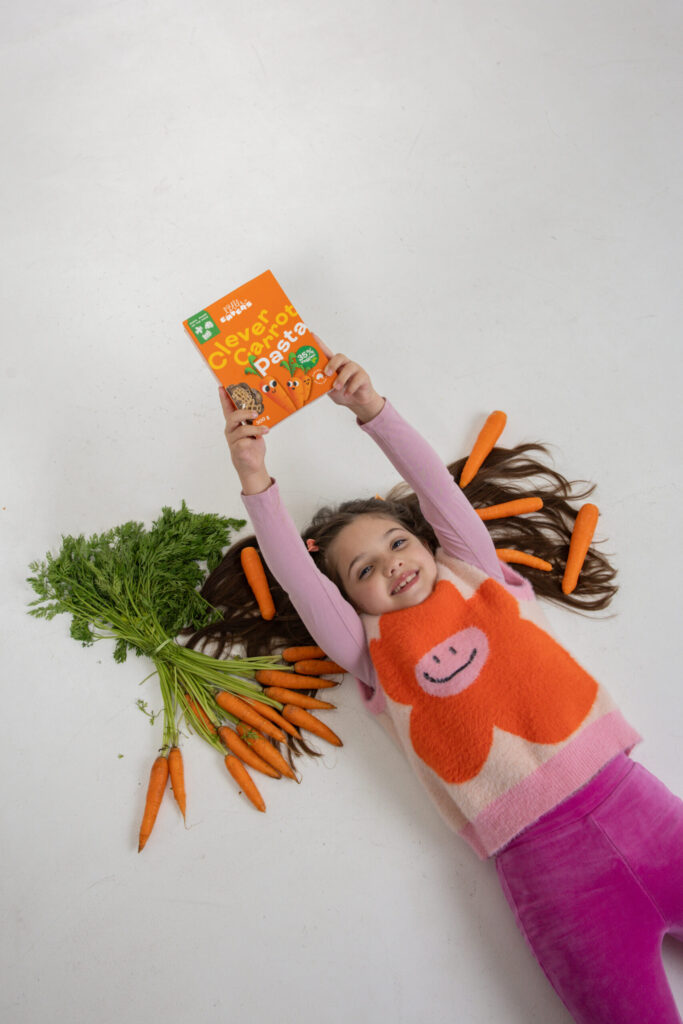
That’s why we call our products Pumpkin Pasta, Carrot Pasta and Beetroot Pasta.
The vegetables aren’t hidden behind clever names or disguised as something they’re not. They’re front and centre, because the goal isn’t simply to get vegetables into children. It’s to help children recognise them, talk about them and see them as foods that belong in everyday family life.
I don’t expect a bowl of pasta to teach a child to love vegetables.
But I do believe it can become one of many small, positive interactions they have with vegetables over the course of childhood.
And that’s always been the philosophy behind Little Eaters.
Final thoughts
If you’ve read this far, you’ve probably realised there isn’t a simple yes-or-no answer to the question, “Should I hide vegetables?” or How do I get my child to eat vegetables?
If blending vegetables into a pasta sauce helps make dinner a little easier this week, go for it! At the same time, I’d encourage you to think beyond today’s dinner.
Children don’t learn to like vegetables because of one meal. They learn through the many everyday moments that make vegetables feel like a normal part of life.
That might be helping unpack the groceries, choosing vegetables at the supermarket, watching you cook dinner, talking about the different colours on their plate or, eventually, tasting something new when they’re ready.
Those experiences probably won’t transform a picky eater overnight. But over weeks, months and years, they help children build confidence around vegetables and gradually develop their food preferences.
As a parent, I found that incredibly reassuring. It reminded me that my job wasn’t to get my children to eat every vegetable I served. My job was simply to keep creating opportunities for them to learn about vegetables without pressure and without turning every meal into a battle.
Looking back, I can’t tell you which dinner changed things for my children.
There wasn’t one.
What made the difference was years of ordinary family meals, supermarket trips, conversations in the kitchen and little moments that didn’t seem particularly important at the time.
I think that’s a comforting thought.
Because it means we don’t have to get dinner perfect tonight.
We simply have to keep showing up.
Written by
Michaela de Maaijer
Michaela de Maaijer is the founder of Little Eaters®, an Australian children’s food brand created to help children become more familiar with vegetables through playful, everyday meals. A former CPA and mum of three from Adelaide, she combines lived experience with evidence-informed guidance to create practical resources for families navigating fussy eating.
- Australian Bureau of Statistics (ABS). National Health Survey: First Results.
- National Health and Medical Research Council (NHMRC). Australian Dietary Guidelines.
- CSIRO VegKIT – Evidence summaries and parent resources.
- Raising Children Network – Healthy eating and vegetables.
- Healthdirect Australia – Healthy eating for children.
- Birch LL. (1999). Development of Food Preferences. Annual Review of Nutrition, 19, 41–62.
- Cooke LJ. (2007). The Importance of Exposure for Healthy Eating in Childhood. Public Health Nutrition, 10(11), 1340–1347.

with the veggies

that are loud and proud

pasta they love